The roof problem that started FalsMount
This is the first entry in what I hope becomes a long logbook. So let me start where the whole thing started: with a bad internet connection.
The connection that never quite worked
Where I live, mobile internet is a coin flip. On paper there’s 4G, sometimes even 5G. In practice the signal drifts, the speed collapses at the worst possible moments, and a video call is a gamble. I tried the usual fixes — different providers, an external antenna, pointing things at the window like a divining rod. None of it was good enough to actually rely on.
So I did what a lot of people are doing now: I ordered a Starlink Mini.
The catch: it needs to see the sky
Starlink is genuinely great, but it has one non-negotiable requirement — a clear, unobstructed view of the sky. Trees, walls, the neighbour’s chimney, the edge of your own house: all of it eats into the field of view and turns a perfect connection into intermittent dropouts.
I walked around the property with the Starlink app’s obstruction checker, holding the dish up in every plausible spot. Ground level: blocked. The terrace: blocked. The fence line: still blocked.
There was exactly one place with a clean view: the roof.
And the roof is the problem
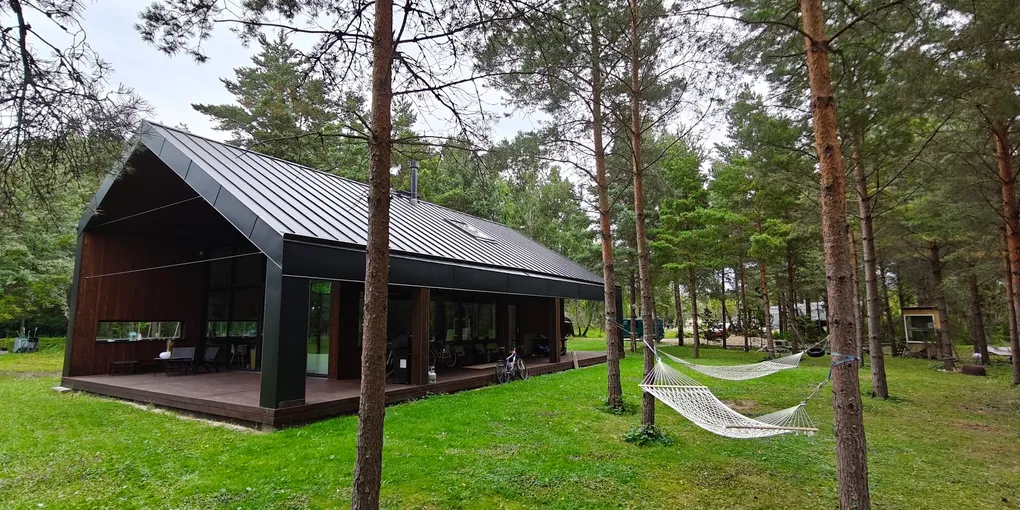
Here’s where it gets specific to Europe. My roof is a standing-seam metal roof — the “Klassik” profile you see all over the Baltics, the Nordics, and the German-speaking countries. Long metal panels joined by raised vertical seams. It looks fantastic. It also has a rule that every roofer will tell you twice:
You do not drill it.
Drilling a standing-seam roof creates a penetration that can leak, and it typically voids the roof’s warranty. The whole point of this roof type is that it’s a continuous, sealed surface. Putting screws through it to bolt down a satellite dish is exactly the kind of thing it’s designed to avoid.
In the US, there’s a healthy ecosystem of no-drill Starlink mounts — non-penetrating roof mounts, seam clamps, ballasted bases. I went looking for the European equivalent for a standing-seam Klassik roof and came up almost empty. Plenty of options that assume you’ll drill. Plenty of options for asphalt shingles that don’t exist here. Nothing that just clamps cleanly onto a European standing seam and holds a Starlink dish.
So I’m going to build it
That’s the gap. And instead of bodging something together with ratchet straps and hoping, I decided to design it properly:
- A clamp that grips the standing seam without penetrating it — no holes, no leaks, warranty intact.
- Fits the common European seam widths (the range I keep measuring is roughly 475–545 mm).
- Tilt adjustment so the dish can aim correctly.
- Works with every Starlink dish size, Mini included.
- Installs in about 20 minutes with basic hand tools.
- Built to survive real weather — think −35 °C to +60 °C, stainless or anodized aluminium.
I’m calling it FalsMount (“fals” is the seam — the Falz).
Right now it’s in mechanical design and early regulatory review. Nothing is final. Plenty of it will change, and some of my first ideas are probably wrong — which is exactly why I want to write it all down as it happens rather than as a clean success story after the fact.
What this blog is
This is the backstory and the ongoing diary of building FalsMount from zero:
- the design decisions and the ones I reversed,
- the clamp geometry that didn’t grip,
- material and coating choices,
- the load and weather testing,
- and the unglamorous regulatory and manufacturing reality.
If you’ve got a standing-seam roof and a Starlink dish — or you just like watching a physical product get built in public — subscribe to the RSS feed and follow along. Next time: measuring seams and why the 475–545 mm range is trickier than it sounds.